Play-Based Learning in Singapore: What to Look for in a Quality Kindergarten Program
A child’s earliest experiences with education can shape how they perceive learning for years to come. For this reason, preschool education has increasingly shifted toward approaches that reflect how young children learn most effectively. Preschoolers are not simply “small adults”; their brains remain highly adaptable and responsive during these formative years, making the quality and type of guidance they receive especially important in helping them realize their unique developmental potential.
Play-based learning has become an increasingly important component of early childhood education because it closely mirrors children’s natural learning processes. Through guided exploration, imaginative play, hands-on discovery, and opportunities for safe social interaction, children develop foundational academic and developmental skills in ways that are both age-appropriate and deeply engaging.
Even so, not all play-based programs deliver the same outcomes, regardless of how similar they may appear at first glance. Meaningful results depend on the right environment and a consistent, intentional approach to learning. A strong program should offer more than cheerful classrooms and attractive facilities—it should thoughtfully integrate play and inquiry to cultivate curiosity, independence, and a lifelong love of learning.
___________
Summary of Contents:
Play-Based Learning: What to Look for in a Quality Kindergarten Program
- What Play-Based Learning Actually Means
- Why Play Matters in Early Childhood Development
- What Parents Should Look for to Identify a Quality Program
- Teachers Who Guide Learning with Intention
- Strong Balance Between Play and Academics
- Meaningful Outdoor Learning Opportunities
- Strong School-Family Communication
- What Families Should Observe During a School Visit
- How Stamford American Supports Play-Based Kindergarten Learning
___________
What Play-Based Learning Actually Means
Play-based learning is sometimes misunderstood as unstructured free time with little educational value. In reality, high-quality play-based programs are intentionally designed to support children’s cognitive, social, emotional, and physical development through carefully planned, age-appropriate experiences. These experiences may include building structures with blocks, exploring water and natural materials, role-playing everyday situations, or collaborating on creative projects—all guided by qualified educators with clear developmental objectives in mind.
A growing body of research suggests that structured play supports healthy brain development and strengthens children’s ability to absorb and retain knowledge. In a kindergarten classroom centered on purposeful play-based learning, young learners are able to form connections more naturally because they actively participate in the learning process. By contrast, traditional rote-based approaches often position children as passive recipients of information, limiting opportunities for the deeper understanding and meaningful connections that experiential learning can foster.
Why Play Matters in Early Childhood Development
Young children learn naturally through hands-on exploration—touching, experimenting, asking questions, observing patterns, and interacting with others. Play creates opportunities to channel these instincts and, with thoughtful guidance, transform them into strong foundations for lifelong learning. While play-based activities may appear simple on the surface, they can serve as powerful tools for developing problem-solving, communication, and critical thinking skills.
For example, building projects in a sandbox can strengthen spatial reasoning while encouraging collaboration and teamwork. Likewise, dramatic role-play activities help children develop communication skills, empathy, and emotional regulation. Outdoor exploration can further support physical coordination while fostering curiosity and strengthening observational and early scientific thinking skills.
This approach is supported by research. Studies referenced by the Center on the Developing Child at Harvard University suggest that enriching experiences during early childhood help strengthen the neural connections associated with learning, self-regulation, and adaptability. These foundational capabilities can have lasting effects on how children navigate academic challenges, build relationships, and adapt to new environments as they grow.
Equally important, play helps reduce unnecessary stress during the early years of development. Research indicates that children who feel safe and emotionally supported are more likely to participate actively, explore with confidence, and take healthy risks in the learning process. Creating this sense of security encourages deeper engagement and supports positive long-term attitudes toward learning.
What to Look for in a Quality Play-Based Kindergarten Program
In well-designed, evidence-informed play-based programs, teachers play an active and highly intentional role in guiding children’s learning. Rather than leaving children entirely to their own devices or directing every activity step by step, effective preschool educators observe children closely and provide targeted, individualized support that extends learning in natural and meaningful ways.
Equally important, teachers in high-quality kindergarten settings recognize that children develop at different rates. They adapt activities to meet individual needs while maintaining focus on broader developmental and learning objectives, ensuring that each child receives support that is both responsive and purposeful.
Teachers also play an essential role in partnering with parents to reinforce learning beyond the classroom. Families benefit when educators clearly explain how classroom activities support development and offer practical ways to continue that learning at home. This continuity between school and home can help create a more consistent and supportive learning experience for young children.
- Strong Balance Between Play and Academics
One common concern among families is whether play-based learning adequately prepares children for future academic demands. Strong kindergarten programs address this by thoughtfully integrating foundational literacy, numeracy, and communication skills into everyday experiences. For example, children may practice counting through structured play activities or expand their vocabulary through interactions with teachers and peers. For older children, reflective writing and project-based activities can also be incorporated into experiential learning to strengthen logical thinking, literacy development, and self-reflection.
Finding the right balance is essential. Programs that place excessive emphasis on rigid academic drills at a very young age may diminish children’s natural curiosity and enthusiasm for learning. At the same time, classrooms that lack intentional structure and guidance may not provide sufficient preparation for more demanding academic environments later on.
The most effective approaches recognize that early childhood education does not require a choice between play and academic readiness. Instead, they use purposeful, developmentally appropriate experiences to build both a love of learning and the foundational skills children need to succeed in the years ahead.
- Meaningful Outdoor Learning Opportunities
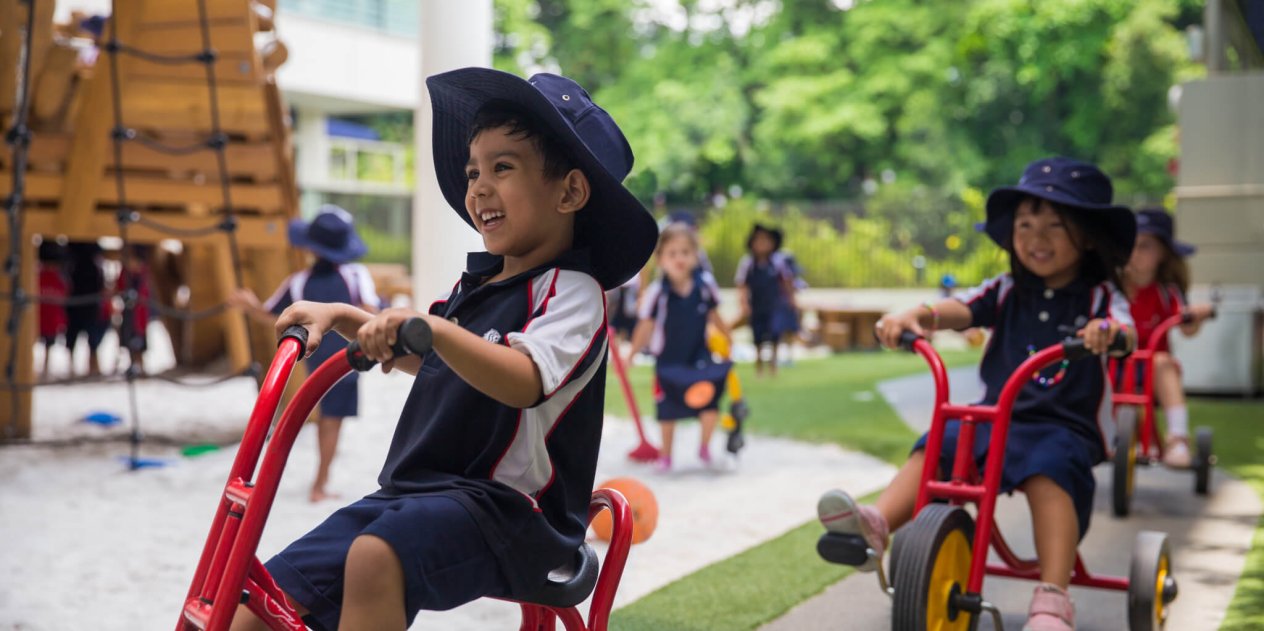
Outdoor learning opportunities are another important marker of a high-quality kindergarten program. In highly urbanized environments such as Singapore, even limited outdoor time is sometimes treated as a welcome addition rather than an essential component of early education. However, within effective experiential learning models, meaningful time outdoors is recognized as a core part of preschool development.
Encouraging children to engage with outdoor environments supports far more than physical activity alone. It helps develop coordination and gross motor skills while building confidence in movement and physical independence. Outdoor experiences also create opportunities for exploration, observation, and open-ended discovery—extending learning beyond the boundaries of the classroom.
Outdoor environments also complement inquiry-based learning by creating natural opportunities for exploration and discovery. Children can observe plants and insects, build structures, and engage with natural materials in ways that encourage curiosity, experimentation, and independent thinking.
Research further suggests that regular access to outdoor activity may support children’s ability to regulate emotions more effectively, which can contribute to stronger engagement and improved learning outcomes across other areas of development. At the same time, shared outdoor experiences encourage social interaction and collaborative play, both of which are associated with more positive classroom learning experiences.
- Strong School-Family Communication
Crucially, the strongest preschool programs recognize that learning extends beyond the classroom. Open communication between educators and parents helps families better understand their child’s development and the educational approaches being used, while creating greater continuity between learning at school and at home.
Programs that actively encourage family involvement can also help children feel more supported and confident as they transition into the more structured environment of elementary education.
What Families Should Observe During a School Visit
Families exploring international preschool options in Singapore should consider scheduling school visits before making a decision, as in-person visits often provide insights that brochures and websites alone cannot. Visiting a campus allows families to observe how children interact with teachers, how classrooms are organized, and whether the facilities and learning environment align with their expectations and values.
When evaluating a preschool, consider the following questions:
- Do children appear actively engaged, curious, and confident in their environment?
- Are teachers interacting warmly, attentively, and respectfully with students?
- Does the classroom encourage exploration, collaboration, and independent thinking?
- Are learning activities developmentally appropriate and purposeful?
- Do teachers clearly connect play-based experiences with meaningful learning goals?
Reflecting on these questions—and speaking directly with educators—can help families determine whether a program genuinely supports holistic development and creates an environment where preschool-age children can thrive.
How Stamford American Supports Play-Based Kindergarten Learning
At Stamford American’s early years programs, preschool-age children take part in experiences designed to foster exploration, creativity, collaboration, and problem-solving within thoughtfully curated learning environments. Guided by a Reggio-inspired philosophy, Stamford American’s Early Years programs place strong emphasis on social-emotional development and hands-on discovery as essential foundations for early academic growth.
Our approach to early learning is further enriched through specialist programs in music, physical education, bilingual language learning, and creative expression, giving children meaningful opportunities to explore new interests and communicate their ideas in diverse and engaging ways.
In its musical education, Stamford American incorporates the Suzuki Program, which is based on Dr. Shinichi Suzuki’s “Mother-Tongue Approach.” Drawing inspiration from the way children naturally acquire language, the program encourages musical development through listening, repetition, positive reinforcement, and a supportive learning environment. Beyond building musical ability, the Suzuki philosophy also places strong emphasis on nurturing children’s confidence and character from an early age.
Physical education at Stamford American, on the other hand, is designed to support children’s development through enjoyable, movement-based learning experiences. The program builds strong foundations by helping children develop fundamental motor skills that prepare them for future participation in sports and other physical activities while also supporting classroom learning through abilities such as fine motor control for writing and visual tracking for reading. It also enhances cognition by using physical activity to strengthen the connection between the brain’s hemispheres, contributing to improved processing speed, memory, and concentration. Taking a holistic approach, the program nurtures not only physical development but also the social and emotional skills children need to communicate effectively and build positive relationships as they grow.
A key component of the early years physical education program at Stamford American is the Perceptual Motor Program (PMP), which uses engaging and structured activities to connect sensory perception with motor skills and physical movement. As children navigate a variety of age-appropriate challenges, they build confidence, resilience, and social competencies such as communication and collaboration. These movement-based experiences also strengthen concentration, memory and sequencing, problem-solving, and other cognitive skills that support learning both inside and outside the classroom, all while fostering a positive relationship with physical activity in general.
Together, these specialist programs complement Stamford American’s Reggio Emilia-inspired approach to education and give children meaningful opportunities to explore and create, as well as to collaborate with their peers. Our purpose-built Early Learning Village further enriches these experiences with its thoughtfully curated facilities and well-designed indoor and outdoor spaces that encourage curiosity and hands-on discovery.
Families interested in learning more about Stamford American’s preschool program can engage in a virtual admissions tour. They may also connect with our admissions team or schedule a campus visit to experience the learning environment firsthand.